
Baseball history
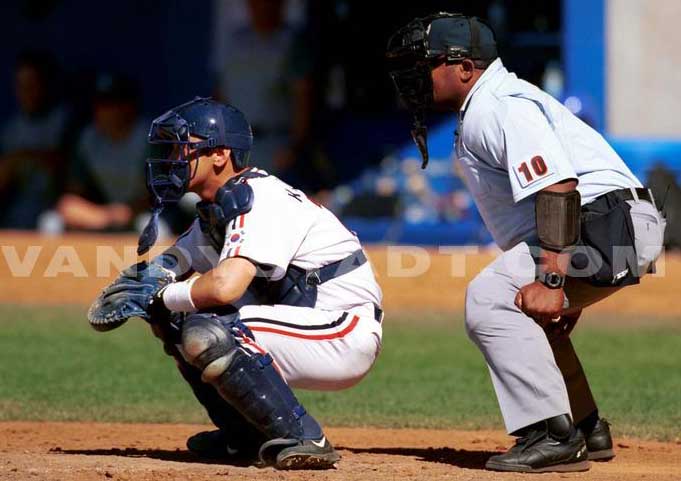
Baseball Olympic Sports
History
Several countries claim the honor of starting games organized. Baseball is a sport "natural", where all sorts of activities take place during the game: hit, run, run. The speed of the mind to the many game situations, make this game a first-class sport. And because the game actions are natural, it may be from different countries. For the United States, the game was invented in 1839 by Abner Doubleday when he invited soldiers based in Cooperstown, NY to perform a game that involves hitting a ball with a stick and cover a course made of purposes. In 1845, Alexander Cartwright founded the first club ball, "the Knickerbockers, New York. Cartwright then develops rules and thus became the real founder of modern baseball. In 1857, 16 clubs already existed, and the basic rules that we know today appeared. The first professional club was established in 1869, and the National League in 1876. In 1900 was born to turn the American League. Since 1905, the two leagues compete annually for the World Series. There are other explanations, from the great similarities with the English cricket, rounders English schlagbal the German, French and rounders. To go further in the past, some sources suggest that the game was invented some 40 centuries ago by the Egyptians. They practiced the spring on the banks of the Nile. Subsequently, the development of Islam gradually spread the game to Europe. In Spain he was introduced by the Moors, and for several centuries it was practiced in the religious activities of Easter. He lost all his subsequent religious significance.
Baseball was introduced in England in 1890 with a great American professional, Albert Spalding, organizer of the first world tour.
The first federations in Europe were created by the British in 1890, followed by Holland in 1912, the Belgians in 1923 and the French in 1924. The first international match was played in 1929.
The European Confederation
was founded in 1952 with two dominant countries: Italy and the Netherlands. In France, even before baseball was practiced the library, sports still practiced by some schools. By 1912, baseball was played by six clubs in the Paris region: Ranelagh BBC, AA Lycee Condorcet, Racing Club de France, etc.. And a few clubs Province: Evreux AC, etc..After the 1924 Olympics, the White Socks Chicago and New York Giants, disputed some exhibition matches at the Olympic Stadium of Colombes. The same year,
the French Federation of Baseball
and theca was created by Frantz Reichel. The league baseball in Paris, founded by François Gaston, merged with the Federation since 1926 and is held annually in France championships.
The first federations in Europe were created by the British in 1890, followed by Holland in 1912, the Belgians in 1923 and the French in 1924. The first international match was played in 1929.
In France, before baseball was practiced the library, sports still practiced by some schools. By 1912, baseball was played by six clubs in the Paris region (eg BBC Ranelagh, Condorcet, Racing Club de France) and several provincial clubs (Evreux).
In 1924 the French Federation of Baseball and rounders, was created by Frantz Reichel.
The International Baseball Federation
(IBAF) was founded in 1938 (110 nations affiliated). Baseball has 130 million practitioners (18 million of license 600 000 licensees in Europe).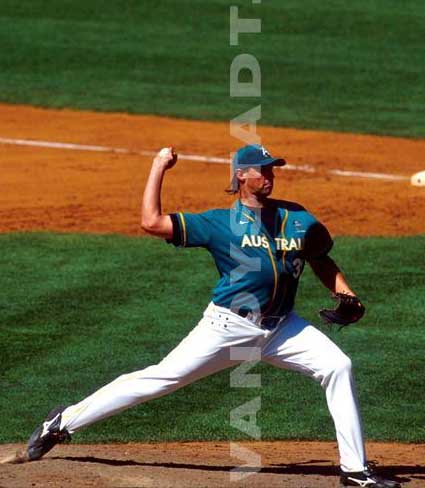
Key Dates
1875 First recipient mask worn by Jim Tyng of Boston (to reduce the cost of dentist).
1876 Birth of the National League. First glove used by Charlie Waite.
1884 First bats manufactured in Louisville.
1885 First breastplates.
1900 The plate is to invent it.
1901 Birth of a rival professional league, the American League. First leg to recipients. The first two balls hit off-line (foul ball) become taken.
1904 The best team from each league are selected to compete for the title named"World Series".
1909 A damped-fault on a third strike eliminates the player.
1920 Chicago Eight players are excluded for life for having deliberately lost the World Series in 1919.
1924 The Chicago White Socks and the New York Giants, disputed some exhibition matches at the Olympic Stadium of Colombes.
1927 Babe Ruth sets record of legendary home runs in a season: 60. This record is 34 years!
First game in 1933 among the stars of the National League and American League.
1947 Jacky Robinson is the first black to play in the Major Leagues.
1965 First stage covered with artificial turf: The Astrodome in Houston.
1971 The drummer helmet becomes mandatory.
1973 The designated hitter rule was adopted in the American League.
1974 Hank Aaron beat the circuit record held by Babe Ruth with 755.
1985 Pete Rose beats the record held by hits with Tyrus Cobb 4 192.
1998 September 8, Mark McGwire beats the record of legendary home runs in a season: 62 (145th game).
2007 August 6, 2007, Barry Bonds equals the record of legendary home runs in his career since 1974 belonging to Hank Aaron in number 755.
On September 8, 1998
, Mark McGwire beats the record of legendary home runs in a season: 62 (145th game). It brought down the old record of 61 home runs set by Roger Maris in 1961. He then brings the record to 70. The selling price of this ball-70th home run reached the sum of 18 million francs.
Baseball and Olympism
The American baseball was a demonstration sport in 1912 (with Jim Thorpe leading the United States to victory against Sweden), 1936, 1956, 1964, 1984 and 1988, the Finnish baseball (Pesäpallo) was on the program for the Games of 1952 Helsinki. In 1992, baseball has become a true Olympic sport where eight teams compete.
Competition
Baseball is a game of defense and attack between two teams of nine players.
The goal is to send a ball with a stick or a bat as far as possible in order to go around a field with several places where players can stop. To win the game, he must score the most points on nine occasions. The turn at bat ends when three of its batters have been expelled.
The playground
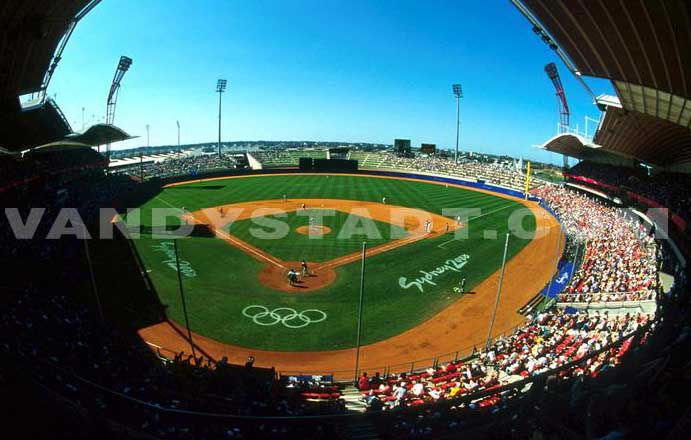
Baseball is played on a field of grass (or Astroturf) and clay called 'diamond' because the infield, the area between the plate and to the three bases, like a diamond.
The infield
is a square of 90 feet square. The outfield is the area between the two lines of play that are extensions of two sides of the square.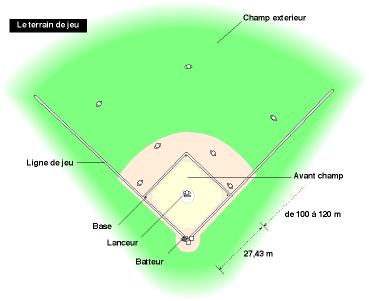
The fields inside and outside, including the boundary lines, are the playground any other surface area is out.
Do you
That baseball can reach speeds of 160 km / h. cons 118 km / h in softball. A ball in baseball (circumference: 22.8 cm) is also tough in softball (circumference: 30.4 cm).
Equipment
The ball
is a sphere formed by yarn wound around a small ball of cork, rubber or similar material, covered with two stripes of white horsehide or beef firmly sewn together. The ball must weigh at least 141 g and not more than 149 g and measuring 7.5 cm in diameter.
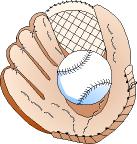
The stick or bat
must be round and smooth, have more at its thickest part and have a maximum length of 1.07 m. 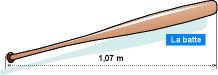
The stick can be:
- A piece of solid wood
- A set of two or more pieces of wood glued together so that the grain of all pieces is essentially in line with the length of the stick. Only wood, glue and adhesive are components of a stick, with the exception of finishing products.
All players must wear uniforms identical in color, cut and style.
Beginning and end of the game
First, the manager of the home team gives the batting order his team to the chief adjudicator in duplicate.
Then, the manager of the visiting team provides the batting order his team to the chief adjudicator in duplicate.
Players of the home team must take their defensive positions, the first batter of the visiting team must take a stand in the batter's box, the umpire shouts "Play Ball" and the game starts.
When the ball is put in play at the start or during the game, all fielders other than the recipient must be in the territory of good balls.
A true legend ofbaseball, Japan's Sadaharu Oh managed more home runs than any other person during his career: 868 between 1959 and 1980.
Pointing mode
A point is scored each time a runner advance and regularly hits the first, second and third base and home plate before three players are removed to end the inning.
When the winning run is scored in the last half-inning of a regulation or part in the second half of an extra end, following a shot on goal, a ball hitting the batter or any other game with the bases loaded, forcing the runner advance to third base, the referee does not signal the end of the game until the runner forced to leave the third base touches the marble and the batter-runner touches the first goal.
Some regulatory · consists of nine innings.
If tied after nine innings complete, play continues until:
· The visiting team has scored more total points than the home team at the end of a completed inning, or
· The home team scores the winning run in a being.
Namely: Within the core (27.43 square meters wide), the distance between the pitcher is the drummer of 18.43 m.
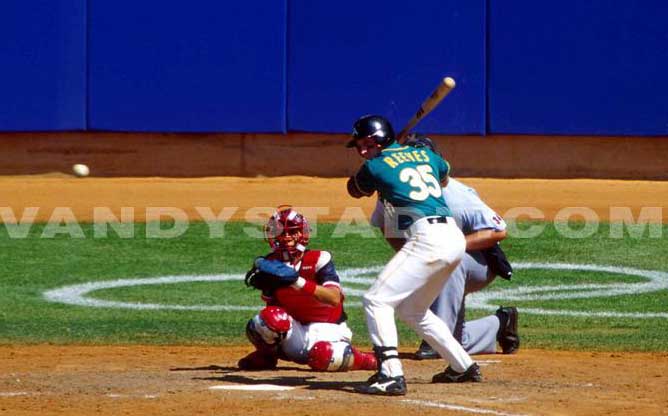
The pitcher-batter duel
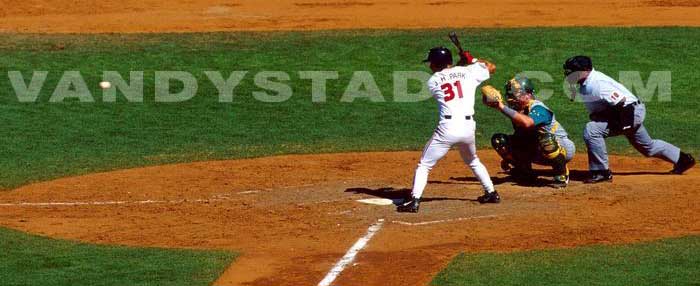
The pitcher throws a ball to the catcher and the batter tries to hit her in the regulatory field or let it pass. He thinks if he misses that ball does not pass through the area "taking" (''strike "in English).
The area taken is the space above the marble and the line between the knees and armpits of the batter.
If the rocket launches in this space (the referee behind the catcher who judge) and the batter decides to pass the ball, it is taken against him. If the shooter rolls outside the zone and the batter decides to let go, it's a ball for the batter.
What happens if the batter tries to hit the ball?
· If the missing is taken against him.
If · key but returns in the zero field is also taken.
· If you type in the regulatory field, the batter becomes a runner (see above) and tries to reach base.
If the batter receives three strikes, it is removed and another player takes his place at home plate. If the batter receives four "bullets" he automatically grants first base. It is easy to realize the importance of the pitcher in the game after the above: the pitcher is in fact an expert in "handling" of shots. He turned the ball different ways and he launches a speed greater or less (up to 120 km / h) so that the batter has misjudged the speed at which the ball comes to him and can not hit.
Withdrawals
The defense team withdrew players of the opposing team at bat and on the basis of several ways:
1. On three doses.
2. When a fielder catches a batted ball before it touches the ground - be it a "candle" or a "bullet line".
3. When a fielder touches a runner - the ball is in his hand or his glove - while the rider is no longer in contact with the base.
4. When a rider is "forced" to move forward because the batter became a runner (two riders can not occupy the same base) and the defensive player in possession of the ball touches the base to which the runner is heading. Withdrawal on first base is a special case of this rule.
Important Details
A runner must return to the base he just left after making the flight by a defensive player, a batted ball.
A rider is always right to steal a base (inattention on the launcher on a passed ball by the catcher on a wild pitch for a defensive player, etc..) When the ball is in play
Softball
Its original name was Mushball the kittenball or baseball indoors.
History
Softball is a variation of baseball that is played indoors and outdoors.
Invented in 1887 by George Hancock, an American journalist at the Chicago Board of Trade for baseball players wishing to continue the practice of baseball during the winter. The sport has been popular in Europe by U.S. military during the Second World War.
Currently it is mainly women who play softball (in schools and universities). The main rules are identical to those of baseball.
Key Dates
1933 Foundation of the Amateur Soft Ball Association of America (ASA)
1965 First World Championship women's fast pitch
1966 First World Championship men's fast pitch
1987 First World Championship of slow-pitch
There are some differences:
. The ball is larger and softer (circumference 30.2 to 30.8 cm, weight 177 to 200 grams). She was struck by a metal bat and not wood like in baseball.
· Gloves are longer and wider to catch a ball wide.
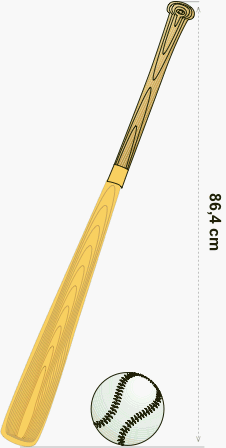
· The length of the bat must not exceed 86.4 cm.
· Distances of softball field are lower (18.29 m 27.43 m cons).
.
· The distance between bases is 13.11 m (18.43 m in baseball)
· The pitcher throws the ball just underneath.
· The field is smaller (18.29 m 27.43 m cons).
· The ball speed record throw is 130 km / h against 160 mph in baseball.
• The pitcher throws the ball only bottom and not from above.
There are two versions:
· The slow-pitch or lentequi ball is played with ten men. The amortization and theft basis are not permitted, the pitcher must throw the ball in an arc of a circle, then more slowly.
· The fast-pitch or rapidequi ball is played to nine. The pitcher can throw the ball faster than slow-pitch. There is a World Championship for Women since 1966.
Demonstration sport at the 1996 Olympics, the women's softball became an Olympic sport in 2000 in fast-pitch version.
Four players are part of the sacred American team three times Olympic champion in 1996, 2000 and 2004: Laura Berg, Leah O'Brien Amico, Lori Harrigan and Lisa Fernandez.
Glossary
Dugout: semi-enclosed area beside the playground where players sit when not participating actively in the game
Cushioning: drummer attempt to sink the ball rather than hit.
Ball: Running outside the area making the drummer is not trying to hit.
Ball-change speed: Start slowly sent in order to surprise the batter.
Curve Ball: Lancer performed with a rotation which bend the ball movement.
Bullet Direct ball thrown directly in a straight line roughly parallel to the ground.
Ball in Play: Ball is played.
Ball rolling: Launch combines a fastball and a curve ball, hit nearly as hard a fastball but with a rotation which bend the ball movement slightly more than a curve ball.
Rising ball: ball hit into the air to the outfield.
Passed ball: Failed recipient when trying to catch a good start, allowing the rider to achieve the following basis.
Fastball: Running as fast a pitcher.
Falling Ball: Slap Shot with a plug that drops the ball lower when it reaches the plate.
Base: One of the three positions protected for the batter or runner.
Solid bases: Bases are called solids where a rider on each of them.
Drummer: players trying to hit a pitch.
Blocker: Bats normally placed between the second and the third player base.
Good ball hit ball in the playground
Outfielders: Gaming zone within the lines of play and beyond the infield.
Infielders: Zone-shaped diamond formed by the three bases and home plate.
Candle sacrifice rising ball hit far enough to allow the runner third base to score a point after catching the ball.
Home run: hit that ball out-of-bounds allowing the drummer to round the bases.
Rider: Drummer who has reached base safely.
Runner Emergency player who replaces a rider of his team once during a game.
Runner in scoring position: players in position to score a point on most shots, especially when speaking of a runner on second or third base.
In the circle waiting: Location of the next player to launch.
Defender: Bats placed behind the plate receiving the shots.
Double: Strike that allows the batter to reach second base.
Double play: Game in which a single run results in two outs.
Forced Removal: Removing performed when a player base, forced to run because another teammate must run to the base it occupies, can not reach the following basis.
Error: Failing a defender who leaves a drummer or a runner to reach base.
Foul ball: ball hit outside the line of play
Feint irregular irregular movements, often deceptive, the thrower, penalized by the announcement of a ball or advancing runners one base.
Batting Emergency players who bat in place of a teammate once during a game.
Designated hitter: players who bat the ball instead of his teammate designated (usually the pitcher) in the composition of the team at bat.
Glissade: rider's Maneuver in which the player slides into a database so that you do not have to slow down to avoid the miss and the defender can easily eliminate by touching with the ball.
Grand Slam: Home run carried out with a runner on each base, worth four points.
Home run: Run the drummer who usually crosses the outfield fences, allowing it to safely reach all the bases (also Home run).
Thurs every suicide risk: Game in which the drummer cushions to try to let the player of the third base score a point. The difference between this game and play any normal risk is that the runner starts to run toward the plate when the throw is made.
Thurs daredevil: Game in which the drummer cushions the balls to try to let the player of the third base score a point.
Center fielder: Defender placed in the center of the field (near the middle of the outfield).
Bats right: Outfielder located right on the ground (right side of the outfield from the perspective of the drummer).
Outfielder: Defender set to one of the three outfield positions.
Bats: Left: Outfielder placed on the left field (left side of the outfield from the perspective of the drummer).
Infielder: Bats placed at one of the four infield positions, not counting the pitcher and catcher.
Player of second base: Defender placed near second base.
Third base player: Defender placed next to third base.
Launch: Ball hit by a batter allowing it to reach the base.
Run mad Lancer so bad that the runner advance to the following bases.
Starting on basis: Play between shots in which a defender removes a runner by touching with the ball when he departs or from first base.
Launcher: Player who throws the ball to the batter.
Relief pitcher: Launcher replacement during a party.
Goal line: Direct line between each base, the runner must go.
Lines of play: Two straight lines from home plate to the outfield through the outer edges of the first and third bases, which define the area of good balls.
Marble plate with five sides rubber milled wide by 17 inches (40 cm), beside which the batter takes a pitch to hit.
Walking: Moving towards the automatic first base after the third shot launcher.
Berm: A pile of dirt in the middle of the infield from where the pitcher throws the ball.
Track Warm up: Area where policyholders awaiting replacement, or are preparing to enter in.
Plaque: Plaque placed on the mound, beside which the pitcher must plant his back foot when it launches.
Point: Point scored when a batter or runner reaches home plate.
Pointer: To strike the ball in the air in the infield.
RBIs: Credit after a batter gets a turn at bat for a teammate to score a point.
First player base: Defender placed next to first base.
Prime launcher: Launcher every team in the game.
Prize: 1. Launch judged by the arbitrator as having passed the marble between the armpits and the top drummers of his knees. 2. Start the drummer missing while trying to hit the ball. 3. Foul ball while the batter is less than two taken against him.
Drummer Rectangle: Area located behind a rectangular plate of purpose and where is the drummer to beat a throw.
Reprise: Tour to the attack and defense of each team.
Withdrawal of three doses: Withdrawal when the drummer did three takes.
Ricochet: ball barely touching the bat before continuing on to the recipient.
Stock: hit the ball along the ground.
Sacrifice: Cushioning allowing a runner to reach the next base while the batter out.
Simple: Coup which allows the batter to reach first base.
Triple Smite which allows the batter to reach third base.
Triple play: Game in which three outs are made with a pitch.
Vol: runner who manages to achieve the following basis, usually during a pitch is not hit.
Support Zone: Zone beyond the marble between the drummer's armpits and the top of his lap, where a pitch is called a decision even if the batter does not try to hit the ball.
Two legendary players
Omar Linares (22-10-67) CUB. The best third baseman in the world among amateurs. Olympic Champion in 1992 and 1996 (2nd in 2000). He holds the Olympic record of highest number of hits (51), the largest number present on the marble (115) and more home runs (14). It is also the only baseball player to have participated in 27 games. Eight times world champion. In 2002 he became the first Cuban player allowed to become an international professional (joining the club Chunichi Dragons of Japan).
Orestes Kindelan (1-11-64) CUB. A big hitter (487 homers in his career!). Olympic Champion in 1992 and 1996 (provides 9 home runs in 9 games), silver medalist in 2000. Five times world champion.