
Shooting history

Tir - Sport olympique
Historique
Les premières apparitions des armes à feu datent de la fin du XVe siècle. A l’origine, le tir servait pour chasser et se nourrir, et bien sûr comme arme de guerre. Le tir s’est transformé en sport au 19è siècle, surtout dans les pays anglophones. La National Rifle Association a été fondée en 1871. En 1858, l’Américain Samuel Colt mit au point le système du barillet. Les frères Clair déposèrent le premier brevet de l'arme automatique en 1888. Dès 1858, les règles élémentaires apparaissent et l'on retrouve en Suisse vers 1860 les premières sociétés de tir. Les pigeons d'argile propulsés en air par des lanceurs automatiques remplacent les pigeons vivants. Le tir devient alors une discipline de sport. L'Union Internationale de tir fut créée en 1887 et en 1896 le tir fut admis aux Jeux Olympiques. En 1897 à Lyon eurent lieu les premiers championnats du monde.
La Fédération Internationale de Tir sportif (ISSF)
fondée en 1907, compte 151 pays membres.
Le tir et l’Olympisme
Le tir a toujours fait partie du programme olympique sauf en 1928. Le tir féminin n’entre dans l'Olympisme qu'en 1984, toutefois entre 1968 et 1980, quelques épreuves étaient mixtes. Le tir olympique comprend 17 épreuves contre 3 en 1896, dont 7 pour les femmes et 10 pour les hommes.
Compétition
Le tir se
ise en deux groupes :
1-
les épreuves de tir sur cibles fixes
pour les armes de poing : carabine et pistolet.2-
les épreuves de tir sur plateaux (
une cible mobile ou “pigeon d’argile”) pour les armes d’épaule : fosse olympique, sanglier courant, ball-trap et skeet.Selon l’arme, il existe quatre groupes différents : fusil, carabine, pistolet et cible mobile.
- les épreuves au fusil voient des adversaires s'opposer en tirant sur des plateaux lancés dans différentes directions.
- les épreuves à la carabine et au pistolet se déroulent dans des stands avec des concurrents visant des cibles à une distance de 10, 25 et 50 mètres. L'épreuve de cible mouvante ou mobile oppose des tireurs sur une cible qui passe dans une ouverture de deux mètres, à une distance de 10 mètres.
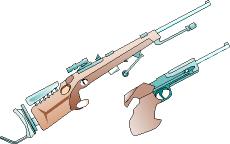
Carabine
- Carabine 10 mètres
Discipline olympique pour les hommes et les femmes. Arme : carabine standard à air comprimé d'un calibre 4,5. Programme : 40 coups pour les femmes et 60 coups pour les hommes tirés debout. Pour la finale entre les 8 meilleures, une série de 10 coups supplémentaires est tirée (ajoutée au score préliminaire).
- Carabine 50 mètres
Cette discipline regroupe les catégories classiques suivantes :

Carabine 3 x 40
Discipline olympique. Arme : carabine libre de petit calibre. Programme : 120 coups sont tirés dans trois positions : 40 coups en position “couché”, 40 coups en position “debout” et 40 coups en position “genou”. La finale entre les 8 meilleurs (après un match éliminatoire de 10 coups supplémentaires) se tire en position “debout”.
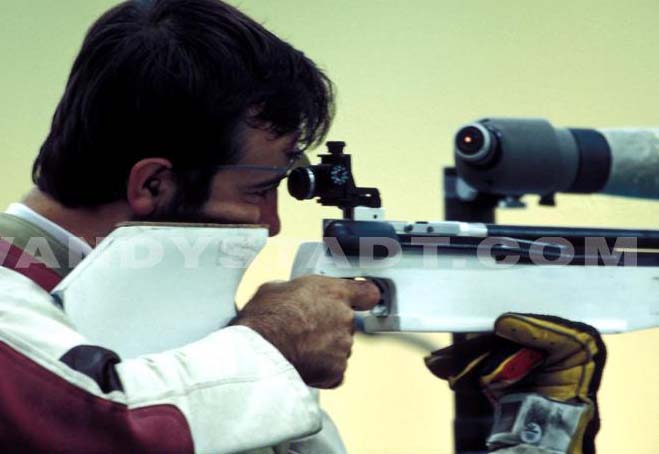
Carabine 3 x 20 balles
Discipline olympique. Arme : carabine libre de petit calibre pour les femmes
- Carabine 60 balles couché ou Match Anglais
Discipline olympique pour les hommes. Arme : carabine libre de petit calibre. Programme : 60 coups sont tirés en position “couché”.
Le tir à la carabine fait partie du biathlon.
Pistolet
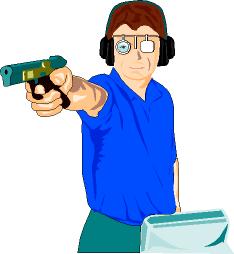
- Pistolet 10 mètres (tir de précision)
Discipline olympique depuis 1988. La cible est à 10 mètres. Le concurrent tire 40 plombs en 1h15 pour les femmes et 60 en 1h45 pour les hommes avec un pistolet à cartouche de CO2 ou à air comprimé. En finale entre les 8 finalistes, une série de 10 coups est ajoutée. Le tir au pistolet 10 mètres est une discipline du pentathlon moderne.
- Pistolet vitesse olympique
Il y a 5 cibles pivotantes, situées à 25 mètres. On tire 60 balles en 2 séries de 30 coups avec un pistolet semi-automatique 22 short. Première série : 2 fois 5 balles tirées en 8 secondes; ensuite 2 séries de 5 balles tirées en 6 secondes et 2 séries de 5 balles tirées en 4 secondes.
- Pistolet sport gros calibre
La cible est à 25 mètres. On tire 30 coups en ‘précision’ avec un pistolet 32 ou 38 (22 LR pour femmes). Ces tirs sont décomposés en 6 séries de 5 balles tirées en 5 secondes ainsi que 30 coups en “vitesse” en 6 séries de 5 balles. Le tireur n’a que 3 secondes pour chaque tir, étant donné que la cible pivotante s’efface 7 secondes entre chaque coup tiré.
- Pistolet standard
Discipline mondiale sur une cible située à 25 mètres. Arme : pistolet 22 LR. On tire 60 coups se décomposant en 3 séries de 20 coups : 4 fois 5 coups tirés en 50 secondes, 4 fois 4 coups en 20 secondes et 4 fois 5 coups en 10 secondes.
- Pistolet libre
La cible est à 50 mètres. On tire 60 balles en 2 heures avec un pistolet à un coup (calibre LR22). Ces tirs sont décomposés en 6 séries de 10 coups.
Tir sur Cible mobile
- Cible Mobile à 10 mètres
Discipline olympique depuis 1992 et mondiale depuis 1993. Arme : carabine à air comprimé équipée d'une lunette de visée grossissante.
Calibre : 4,5 mm. Distance de tir : 10 mètres. Trajet cible : 2 mètres. Temps de parcours : vitesse lente (5 secondes) ou vitesse rapide (2,5 secondes). Compétition : 60 coups qui se décomposent en 2 séries de 30 coups (une en vitesse lente et une en vitesse rapide).
- Cible mobile 50 mètres ou "Sanglier courant"
Discipline olympique jusqu'en 1988. Arme : carabine 22 LR équipée d'une lunette de visée grossissante. Distance de tir : 50 mètres.
Trajet cible : 10 mètres. Compétition : 60 coups qui se décomposent en 2 séries de 30 coups (une en vitesse lente et une en vitesse rapide).
1814 : le tir au pigeon vivant est introduit en Angleterre - 1831 : le tir au pigeon est importé à Paris par Bryon (Tivoli et Porte Dauphine) - 1880 : introduction du pigeon artificiel en Angleterre lancé par ball-trap - 1898 : le ball-trap est importé en France - 1910 : le skeet est inventé aux Etats Unis - 1934 : le skeet est importé en France.
Fosse olympique
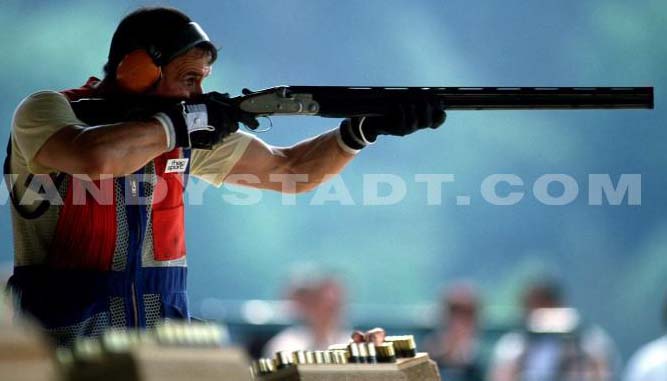
/TrapLa fosse est une tranchée couverte d’un toit dans laquelle on a placé par groupes de trois, 15 appareils de lancement de plateaux ou pigeons d’argile. Le tireur ne connaît ni l’angle ni la vitesse des plateaux. Neuf grilles de réglage gèrent les appareils de lancement. Les postes de tir sont à 15 m de l’appareil de lancement. Six tireurs constituant ‘la planche’ occupent tour à tour l’un des 5 postes de tir. La compétition consiste à totaliser le meilleur score en tirant 125 plateaux par séries de 25 plateaux chacune. Diamètre du plateau : 11 cm - épaisseur : 2,5 cm.
La vitesse moyenne d'un plateau peut atteindre les 140 km/h.
Skeet
Autre épreuve de tir sur plateaux inventée par les Américains en 1910. Sur un terrain en demi-lune, il y a à chaque extrémité une trappe ou cabane de lancer : l’une haute (appelée “mark”) lance le pigeon à 3,05 m et l’autre basse (‘pull’) à 1,07 m du sol. Ainsi leurs trajectoires se croisent à 4,57 m du sol à une vitesse de 90 à 120 km/h. Les tireurs qui se déplacent sur huit postes de tir équidistants voient des cibles sous des angles différents (simples : des plateaux uniques lancés depuis une cabane ou doubles : plateaux lancés simultanément de chacune des cabines) et doivent les casser en tirant une seule cartouche par plateau avec un fusil à canon lisse (calibre 12 maximum et la cartouche 24 grammes de plomb). Diamètre d'un plateau : 110 mm pour 110 g. La compétition se déroule sur 125 plateaux (séries de 25) pour les qualifications plus 25 en finale.
Double trap
Trois appareils de lancement situés à 15 mètres des tireurs dans la fosse lancent 2 plateaux en même temps dont la trajectoire, l’angle et la hauteur sont connus du tireur. On tire 3 fois 50 plateaux (25 doublés) ou 3 fois 40 plateaux (20 doublés). On peut tirer avec fusil à canon lisse (calibre maximum 12, 24 grammes de plomb maximum par cartouche).
Petite histoire
Le plus ancien club de tir est le club anglais des “Olds Hats” qui, au début du 19e siècle, a inventé un système de tir sur cible mobile. Il devait son nom à la technique alors employée. Cinq chapeaux hauts de forme étaient disposés en arc de cercle près du stand de tir. Sous chaque chapeau, un pigeon. Au commandement du tireur, un coup sec sur la ficelle reliée à l’un des hauts de forme renversait celui-ci. Le pigeon libéré s’envolait.
Lexique
Les armes
Pistolet : Arme à feu courte utilisant de l’air comprimé ou du dioxyde de carbone pour tirer des balles de plomb. On tire avec une seule main.
Pistolet à l’air comprimé : Pistolet utilisant de l’air comprimé ou du dioxyde de carbone pour tirer des balles de plomb.
Carabine : Arme à feu d’épaule avec des sillons en spirale découpés sur la face intérieure du canon afin de donner à la balle un mouvement de rotation et de rendre sa trajectoire plus précise.
Carabine à air comprimé : Carabine utilisant de l’air comprimé ou du dioxyde de carbone pour tirer des balles de plomb.
Carabine trois positions : Compétition de tir au cours de laquelle les tireurs tirent en position couchée, debout et à genoux.
Cible mobile : Cible fixée sur un rail simulant un animal se déplaçant ou une autre cible.
Double trap : Epreuve de tir à la fosse olympique dans laquelle deux cibles sont lancées simultanément à des hauteurs et angles différents et que le tireur doit toucher.
Fosse olympique ou Trap : Sport de tir sur des plateaux lancés en l’air depuis une fosse.
Fusil : Arme lisse pour tirer des coup ronds.
Skeet : Forme de tir sur plateaux où les cibles sont lancées depuis deux fosses à environ 40 mètres de distance et le tireur se déplace selon un arc de cercle en différentes positions, tirant depuis différents angles.
A savoir :
Mille : Cercle central de la cible lors des épreuves de pistolet, fusil ou de cible mobile d’une valeur de 10 points ; également connu sous les noms « mouche» ou « 10 central »
Mouche : Cercle central de la cible lors des épreuves de pistolet, fusil ou de cible mobile d’une valeur de 10 points ; également connu sous les noms « mille » ou « 10 central ».