
Skateboard history
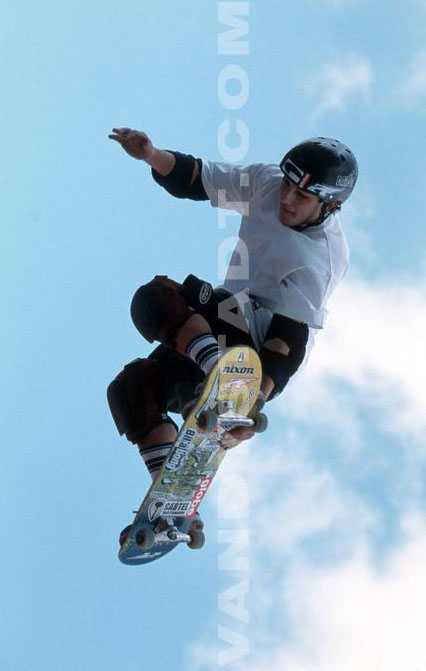
Skateboard
Historique
Le “skate” est né en Californie vers les années 60, inspiré par quelques surfeurs qui ont eu l'idée de fixer une petite planche à des patins à roulettes d'argile. Dérivant donc directement du surf par des californiens afin d’assoiffer leur passion les jours sans vagues.
Les premiers adeptes pratiquent sur les bords de mer mais très vite le skateboard évolue dans les zones urbaines. Les planches sont améliorées par l'utilisation de roues en uréthane les rendant plus sécurisantes et moins bruyantes.
La vague des planches à roulettes arrive en France dans les années 70. Le Trocadéro à Paris devient la nouvelle “Mecque” du skateboard et la discipline profite d'une large médiatisation. En 1977, le Ministère de la Jeunesse et des Sports reconnaît officiellement ce sport ainsi que son rattachement à la Fédération Française de Surf.
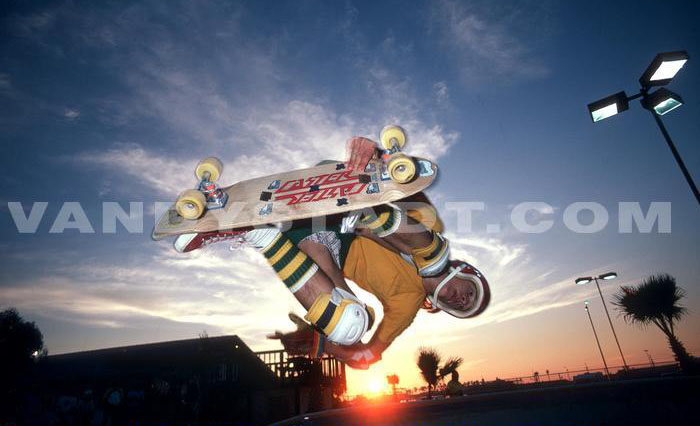
En 1995, les surfeurs ne souhaitent plus conserver en leur sein l'activité skateboard et demandent leur autonomie. Un Comité National du Skateboard est fondé en 1996 et comptait 65 clubs pour quelques 1 633 licenciés. Depuis, on assiste à la naissance de nombreux clubs ayant pour but l'initiation, l'encadrement et l'entraînement des jeunes.
En 1997, le Comité National Skateboard prend l'appellation Commission Nationale Skateboard au sein de la Fédération Française de Rollerskating.
Depuis 1998, cette commission est dirigée par des anciens de la discipline tel Thomas Raymond.
Les premiers championnats du monde officiels eurent lieu en 1977 en Californie. Il existe des championnats d'Europe depuis 1980.
Dans les années 90 de nombreux “skateparks” ou lieu de pratique du skate furent fondés un peu partout en France. Actuellement il existe un circuit “Coupe de France”, un championnat de France (réunissant les 40 premiers au classement des Coupes de France). Parmi les principaux festivals, citons : le “Bowl Rider“ à Marseille rassemblant les meilleurs “riders” de la discipline; le “Fise” de Palavas, un événement qui réunit de nombreux sports de glisse tels le skateboard, le roller, le wakeboard et le flysurf.
Le “windskate” ou “la planche à voile des villes” est une des dernières-nées des sports de glisse où le skate est tiré par une voile. On peut atteindre les 10 km/h
Le record de vitesse atteint sur skate est de 108 km/h.
Le record de saut atteint sur skate est de 58 pieds soit 17,63 mètres, établi en 2001 par l'Américain Brian Patch. L'ancien record est de 52 pieds soit 15,849 mètres par son compatriote Andy Mac Donald.
Quelques dates à retenir :
1962 Le surfeur californien Mickey Munoz en l'absence prolongée de vagues, installe des roulettes sous une planche pour “surfer le bitume”.
1962 Arnaud de Rosnay introduit la première planche à roulettes en France. Cette mode s'appelle alors le “roll-surf”.
1965 Arnaud de Rosnay et son frère Joël organisent le premier championnat de France à Hossegor.
1973 Deux Californiens, Franck Nashorworthy et Bobby Bahn, créent la roue en uréthane apportant silence et sécurité. Le roll-surf devient skateboard.
1974 Le skateboard fait partie de la Fédération Française de Surf.
1978 On compte 6 500 licenciés. Les disciplines prépondérantes sont le slalom, le saut en hauteur et le free style.
1979 Les premières rampes apparaissent sur les côtes californiennes.
1989 550 000 planches vendues en France. De nouvelles disciplines se développent en compétition telle la mini-rampe et le street.
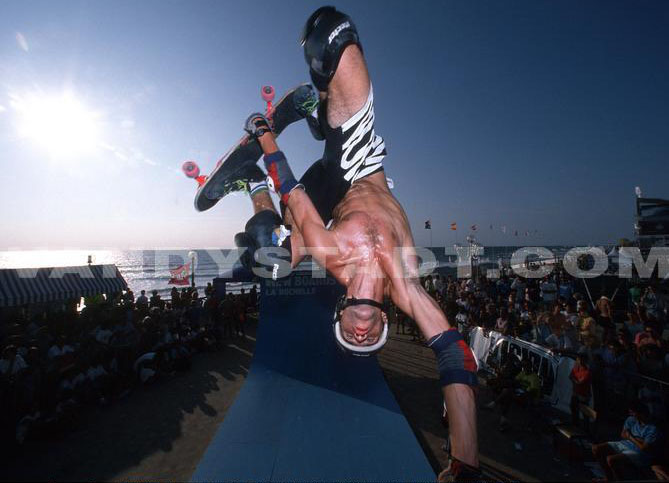
Le matériel
Le skate se pratique sur une planche (longueur moyenne : 50 cm) montée sur roues et munies de roulements à bille. Il existe plusieurs disciplines tels le slalom avec une planche souple et fine (70 cm de long) ou la vitesse avec une planche rigide.
Le plateau, composé de 7 fines lamelles de bois compressées, a une forme concave avec aux extrémités 2 parties relevées appelées “nose” et “tail”. La partie supérieure de la planche est revêtue d'une couche antidérapante, appelée grip. Certaines planches possèdent aussi un revêtement plastique en dessous pour réaliser certaines figures.
Les roues sont fabriquées en uréthane, leur diamètre se situe entre 40 et 60 cm. La dureté exprimée en 'shore' varie entre 80 et 95 A. Chaque roue possède 2 roulements.
Le truck est la pièce directrice du skate qui permet la fixation des roues sur la planche. La fixation est assurée par une embase d'où émerge un axe sur lequel viennent s'encastrer des gommes assurant la mobilisation du système axe-roue.
Les protections sont indispensables à la pratique du skateboard : genouillères, casque et coudières.
Les infrastructures
La rue
L'espace urbain rassemble de nombreux participants qui utilisent le skate comme moyen de transport. La scène des grandes villes se rassemble sur des sites appelés “spots” où l'on trouve plusieurs catégories de modules bitumés ou bétonnés, entourés de courbes, de marches ou plans inclinés. Un bon “spot” est celui qui permet d'évoluer dans les différentes techniques du “street-style”.
Les modules
L'évolution du skate dans la rue a développé l'idée de recréer son propre “spot” en construisant des modules en bois facilement transportables dans des lieux offrant une sécurité et un certain confort. On peut distinguer des modules suivants :
Les marches associées à un “fun-box” utilisées in
iduellement elles sont traversées dans le sens longitudinal pour des slides ou des rollings.
Les “barres à rocks” sont des tubes d'acier souvent associés par paire à une structure rigide permettant de les fixer au sol. Elles peuvent être droites, coudées, en pente ou conçues pour représenter une rampe d'escalier. Cette structure offre des évolutions variées dans le domaine des “slides”.
Les quarters sont de quarts de rampes. Ce sont souvent des modules volumineux, permettant l'initiation aux transitions fixes (rampes, parcs, bowls).
Les banks sont des petits modules qui se définissent par rapport à leur utilisation. L'ensemble de ces 2 dernières catégories forme l'essentiel des composants d'une “aire de street”.
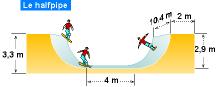
On distingue deux sortes de rampes : les mini rampes caractérisées par l'absence de verticale, et les grandes rampes ayant au moins 30 cm de verticale après la transition.
Les différentes disciplines
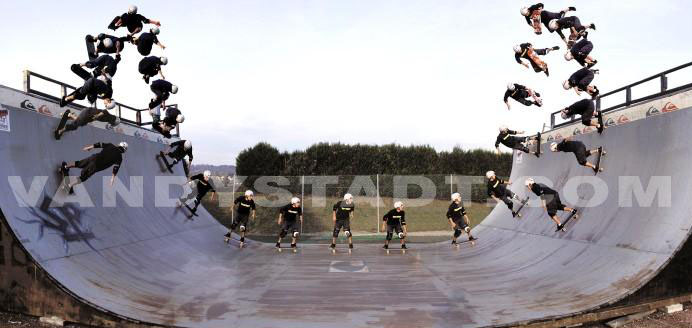
La rampe
Elle se définit comme une association de 2 plans inclinés courbés, reliés à leur base par un plat. Une rampe possède de la verticale dont l'extrémité se termine par un “coping”. C'est la discipline la plus spectaculaire. Les sportifs enchaînent des figures aériennes au-dessus du coping. La durée du passage ou “run” varie selon le mode de sélection. Aux qualifications pour les championnats, chaque participant effectue son passage in
iduellement. En finale, le choix s'offre ou en in
iduel ou en “jam session”.
La mini rampe
C'est également un ensemble de plans inclinés courbés, reliés à leur base par un plat. Chaque extrémité n'atteint pas la verticale et se termine par un coping.
Le street
C'est la discipline qui concerne 80% des pratiquants. En compétition, les skateurs évoluent sur un ensemble de modules placés sur un terrain plat, de façon à couvrir toute la surface et de permettre une utilisation rationnelle des modules. Les modules sont placés en complexes et entourés de plans inclinés. Cette disposition fournit une vitesse initiale au skateur.
Le slalom
Comparable au ski où les portes sont symbolisées par des cônes ou plots en plastique, rouges et bleus. Le skateur est pénalisé s'il renverse un plot. On distingue dans cette discipline :
Le parallèle qui se déroule sur une piste lisse de 30 à 60 m (dénivelé 0 à 4%). Le matériel est constitué d'un chronomètre avec une barrière mobile au départ et une cellule photoélectrique à l'arrivée.
Le spécial qui se déroule sur une pente variant de 0 à 7% avec une barrière pour une longueur de 60 à 100 m comptant 40 à 50 plots.
Le géant qui se déroule sur une pente variant de 0 à 4% de dénivelé pour une longueur de 100 à 300 m comptant 50 à 60 plots.
La descente
Cette discipline se déroule sur une pente variant de 7 à 15% de dénivelé pour une longueur de 300 à 1 000 m.
Bon à savoir
On dit qu'un skateur est “regular” lorsqu'il met son pied gauche en avant, près du nose. On est “goofy” lorsqu'il met son pied droit à l'avant du skate.